CourseEng2
You already have the voice. You're just missing the technique to let it out.
You know the moment: someone hands you the mic, everyone turns, and you say "no thanks, I'll just listen." Then you get in the car and sing that exact song — full power, no fear. That voice is real. It just hasn't been handed the technique to get out of the car yet.

One payment · lifetime access · 14-day money-back guarantee
Which one are you?
In 15 years and 1,000+ voices, almost every stuck singer is doing one of three things — none about talent. Tap each one; many singers are a blend of two.
You're forcing the note — and it's choking the sound
Sounds like you if…
- A lump or squeeze grips your throat the moment you reach for a high note.
- The longer the song runs, the tighter you get.
- Push up and the tone turns heavy and sharp — then your voice aches afterwards.
What's actually happening
Your vocal folds are over-squeezing, and to "help" them your outer throat muscles — the swallowing ones — jump in. The larynx rises, the vowel spreads too wide, you pull in too much air, and the note comes out strangled instead of free.
How Aga fixes it
We take the effort out first. A dopey, yawny "puppy whimper" slide floats the sound up into your head register and switches those outer muscles off. It may crack at first — good. That crack is the false tension leaving.
Left unchecked, this is the tendency that hardens into chronic hoarseness — and, over years, vocal nodules. The one most worth catching early.
Your voice is there — it's just leaking away
Sounds like you if…
- People ask you to repeat yourself; in a group or a choir you vanish.
- Fifteen minutes in, the voice already feels tired, dry and thin.
- It's quiet but still tense — and there's no real power behind what you're trying to say.
What's actually happening
Your folds aren't closing firmly enough, so air escapes around them. That leaking air dries and tires the cords — and, counter-intuitively, the outer muscles tense up to compensate even though you're barely loud.
How Aga fixes it
Volume isn't the answer — closure is. A cheeky, full-exhale "hey!" from the chest makes the folds actually meet and hold. The same effort suddenly carries across a room, with no pushing.
This is the voice people wrongly write off as "just quiet" or "no talent". It's almost always a closure habit — and closure is trainable.
Your voice works — until the seam between registers
Sounds like you if…
- Moving low to high, the voice flips, cracks or lurches without warning.
- There's a hard line where chest suddenly drops into a weaker head voice.
- You hold back and play it safe, because you never know if the note will hold.
What's actually happening
You're already using both registers — but the bridge between them (the Mix) isn't built yet. The tension is uneven: too heavy here, too light there, so at the seam the voice snaps instead of blending.
How Aga fixes it
We even the tension out. Humming slides up and down, plus a bratty, nasal "meh", teach chest, mix and head to hand off smoothly — so the break turns into a bridge you can sing straight through.
The most "fixable-fast" of the three — it's rarely weakness, almost always just an unbuilt transition.
It's not magic.
It's physiology.
Most courses teach "interpretation" and "feeling." I teach you the craft underneath it.
Built on Speech Level Singing and Institute for Vocal Advancement technique — the same principles touring pros use to sing night after night without wearing the voice out.
- Larynx stabilisation — so you stop choking the sound off.
- Breath balance — so the voice is powerful and light, not one or the other.
- Building the Mix — so chest and head voice connect with no crack in between.
students taught
5 hrs
of step-by-step training
Each part fixes a specific problem — in order
You don't jump to high notes on day one. You build the foundation that makes them possible, then apply it to real songs.
Foundations: breath & posture
Goal: stop the strain
Breathe efficiently — the fuel for your voice — and stabilise your instrument. You stop pushing sound from the throat and start singing with your whole body.
Range extension
Goal: reach the high notes without fear
The core of the course. Work through exercises matched to your voice and unlock your upper register without tension or forcing.
Ear training & tuning
Goal: sing in pitch, every time
Connect your ear to your voice, so what you hear in your head is exactly what comes out of your mouth.
Song application
Goal: sing the songs you love
Take the balance you built in the exercises straight into real songs — and hold your technique while you actually feel something.
Don't take my word for it — do a lesson now
Stand up, press play, and do it with me. This is a real breath warm-up pulled straight from inside the course — the diaphragm exercise students run before every session. Feel it switch on, then decide.
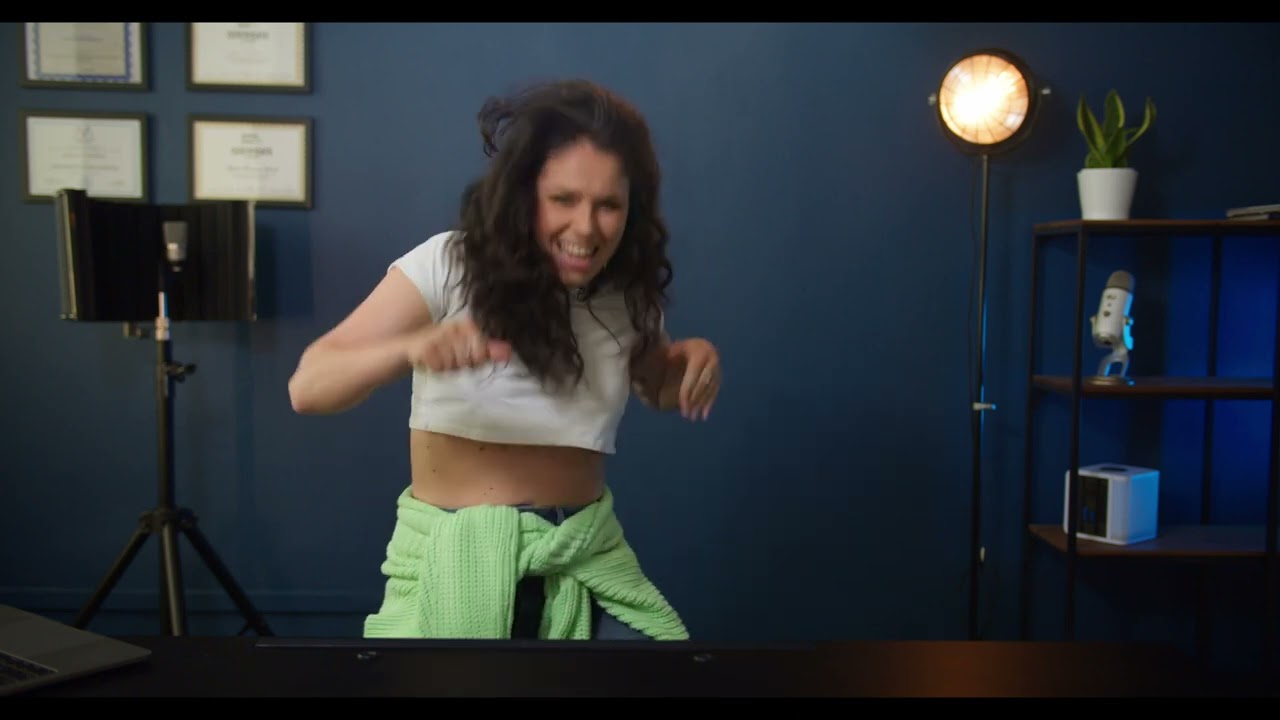
That's one exercise. Inside, 5 hours of them are sequenced so each one builds on the last — and that order is the whole point.

Aga Przestrzelska
Certified singing coach
I believe everyone can learn to sing well. Talent is an easy excuse — technique is the real solution.
15+ years teaching and certified in Speech Level Singing, the Institute for Vocal Advancement, and Modern Vocal Training. I built this course to give you the shortest honest path to a free, confident voice — the one I had to fight for myself.
What people say after the work
"Aga is incredibly knowledgeable, with an energy that makes you want to work even harder. I recommend her with all my heart."
— Magda"A brilliant coach — but what makes her unique is her huge heart and patience. There are no impossible sounds for her."
— M. Bereda"The course fits exactly what I needed. Practising a little every day genuinely lifts my mood — even on the bad days."
— TedOwn your voice — for a one-time price
The big platforms charge you every single month, forever. This is one payment. You keep it for life.
Sing With Aga — full course
Complete online access
Launch price $47One payment. No subscription. The big platforms charge $30–130 a month, forever. This you pay once — and keep for life.
- Step-by-step vocal roadmap
- Breath & posture foundations
- Range extension & building the Mix
- Ear training & pitch
- Song application — technique into real songs
- Lifetime access, on mobile & desktop
- 14-day money-back guarantee
One 30-minute private lesson costs more. This is the whole method.
14 days. No questions.
Buy it, work through it, test it on your own voice. If it's not for you, send one sentence and get every cent back — no hoops, no explaining yourself.
🔒 Secure checkout · card & Apple Pay · instant access after purchase
Straight answers
No. Every exercise is available 24/7 with lifetime access — come back to any lesson as many times as you need.
None. Nothing to download, no experience required — everything is online and starts from the ground up.
Around 15–45 minutes a session. Even 15 minutes a day makes a real difference — consistency beats marathon sessions.
The course is self-study, but private lessons are available separately. You can always reach Aga at info@singwithaga.com.
You have 14 days. Send one sentence and you get a full refund — no questions, no justifying.
This year is going to pass either way. The only question is whether you'll spend it singing.
Spend the next twelve months hunting random YouTube exercises and hoping something sticks — or follow one clear method from a coach who's taught a thousand voices, and finally hear on the outside the voice that's only ever played in your head.
Join the course — $47 ›